Intelligent Buildings Agents Laboratory (IBAL)
The IBAL is a mixed system lab at NIST that is able to test commercial equipment under simulated conditions. For more information, vist the IBAL Database.
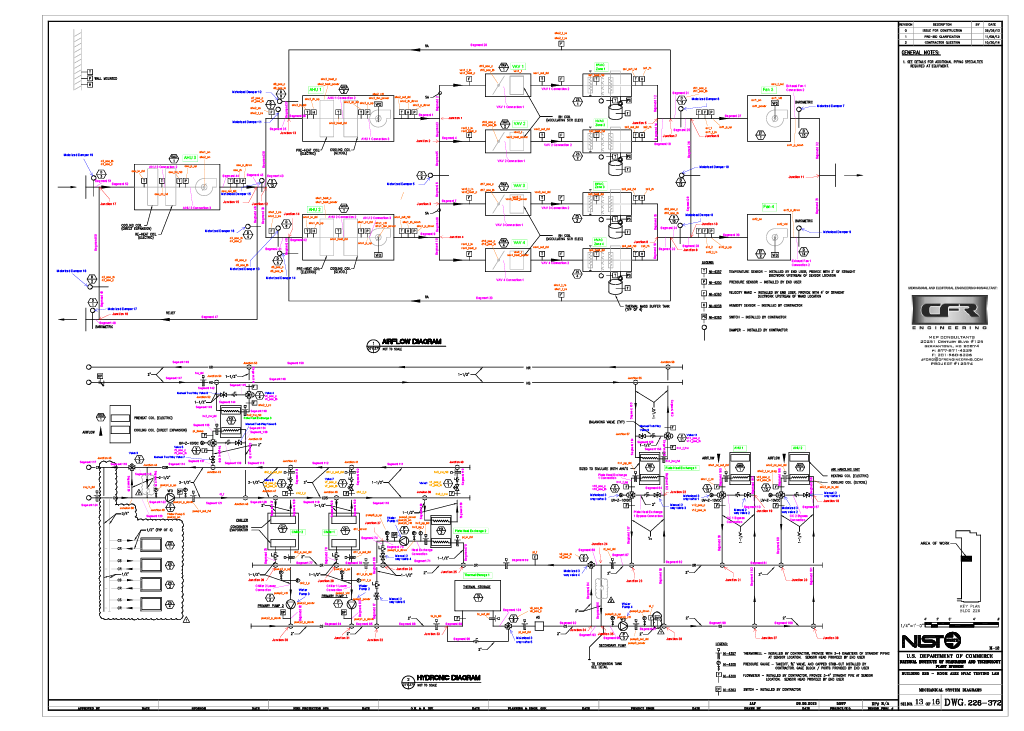
Schematic view
Downloads
What are these files?
Turtle file (original): This is the original source Turtle file that was provided to
models.open223.info, usually as the output of some model creation tool.Turtle file (compiled): This is the original Turtle file with all inferred relationships and values added through SHACL inference against the 223P ontology and other dependencies. You should use this file for any further processing. It does not contain any of the ontologies.
Turtle file (with all imports): This is the compiled Turtle file with all imports included in the file (223P ontology, QUDT ontology, and others). This is helpful when you do not want to deal with downloading and managing ontology dependencies. It is also much larger than the compiled file.
JSON-LD file (original): This is the original Turtle file converted to the JSON-LD format.
Turtle is a syntax for RDF (Resource Description Framework) that is easy to read and write. It is a popular format for representing linked data. Parsers and serializers are available in many programming languages. JSON-LD is a JSON-based format for linked data that is easy to use with JavaScript and other web technologies.
Queries
| Description | Query URL |
|---|---|
| Zone/room temperature sensors | Query Link |
| Search for all the sensors along the connections and the associated property they’re observing. | Query Link |
| Sensors in AHU1 and what units the properties are measured in | Query Link |
Model Components
Load and Validate Model
This code uses the BuildingMOTIF library to load the 223P ontology and the model file into a temporary in-memory instance. It then validates the model against the ontology. If the model is invalid, it will print the validation report.
BuildingMOTIF resolves the ontology’s dependencies with OntoEnv and validates with shifty, both of which are self-contained Rust extensions, so there is nothing else to install and no Java is required.
BuildingMOTIF installation
To install the buildingmotif library, you can use the following command:
pip install 'buildingmotif @ git+https://github.com/NREL/buildingmotif.git@gtf-buildingmotif'from buildingmotif import BuildingMOTIF
from buildingmotif.dataclasses import Library, Model
from datetime import datetime, timezone
import logging
# Create a BuildingMOTIF object. This validates with the "pyshifty" SHACL
# engine by default, so there is nothing else to install and no Java required.
bm = BuildingMOTIF('sqlite://', log_level=logging.ERROR)
# load 223P library. We will load a recent copy from the models.open223.info
# git repository; later, we will load this from the location of the actual standard.
# BuildingMOTIF uses OntoEnv to fetch the ontologies 223P depends on (QUDT, SHACL, ...).
s223 = Library.from_ontology("https://open223.info/223p.ttl", infer_templates=False, run_shacl_inference=False)
# load the model into the BuildingMOTIF instance. This page pins the exact copy
# it was built and validated against, so it stays reproducible as the site moves
# on. To run this against the current published model, use the permanent URL:
#
# model = Model.from_file("https://models.open223.info/NIST-IBAL.ttl")
#
model = Model.from_file("https://raw.githubusercontent.com/open223/models.open223.info/3a47c5eb980eb6d87728eb10cefb38ad6bc83f13/models/NIST-IBAL.ttl")
# a model's manifest lists the libraries it should conform to
model.manifest.add(s223)
# validate the model against its manifest
ctx = model.validate()
# print when validation completed
print(f"Validation run at: {datetime.now(timezone.utc).isoformat(timespec='seconds')}")
# print the validation result
print(f"Model is valid: {ctx.valid}")
# if the model is invalid, print the validation report
if not ctx.valid:
print(ctx.report_string[:1000]) # first 1000 characters of the report
# BuildingMOTIF can also interpret the report to provide recommendations on fixes
for focus_node, diffs in ctx.get_reasons_with_severity("Violation").items():
if len(diffs) == 0:
continue
print(focus_node)
for diff in diffs:
print(" - " + diff.reason())Validation run at: 2026-10-16T15:48:33+00:00
Model is valid: True